

Experience Design
Higher Education
Pro Sports
When Students Ask “Is College Worth It?” Does Your Campus Welcome Center Answer?
I’ve sat in enough boardrooms and conference rooms across higher education to know that the question facing university presidents and enrollment vice presidents right now is not about marketing budgets or application funnel optimization. It’s a more fundamental one, and it comes from the 17-year-old standing in your welcome center with their parent, trying to figure out whether the next four years of their life will actually mean something.
Is this worth it?
That question is louder right now than it has been in a generation. Entry-level hiring dropped year over year in early 2026. More than 41 percent of recent graduates are working jobs that don’t require their degree. Families are doing the math before they ever set foot on your campus, and the math is making them nervous. They are not walking through your doors skeptical of your academic program. They are skeptical of the return. They want proof that this place will change a life.
Here is the problem: you cannot prove that with a brochure. You cannot prove it with a tour script. You cannot prove it with statistics on a wall.
You can only prove it with an experience that makes the future feel real before they’ve enrolled, before they’ve registered for a single class, before they’ve written a check.
That is the work. And most institutions are not doing it.
Someone will give a million dollars because of a moment you engineered. Someone will enroll because they felt like they belonged.
The Gap Between Looking Good and Actually Working
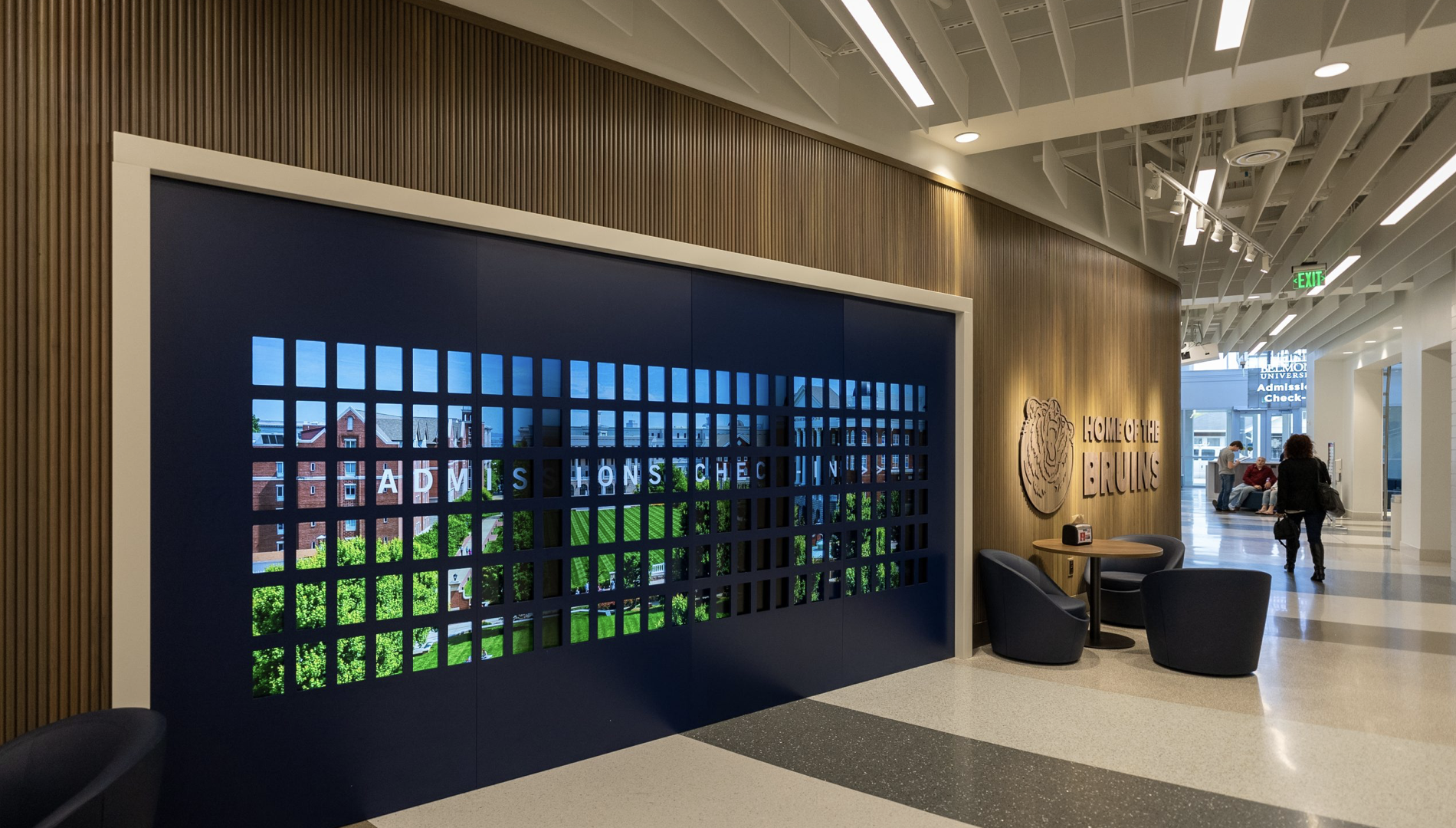
Spend any time walking through university welcome centers or athletic recruitment facilities and you find a recurring pattern. Beautiful spaces. Impressive architecture. Significant capital investment. And a persistent, uncomfortable silence underneath all of it.
The buildings are impressive. The signage is polished. The screens are bright. But there is a gap between what these spaces look like and what they actually do. That gap is costing institutions more than they realize, and in an enrollment environment this competitive, it is a gap they cannot afford.
I make a distinction in my work with enrollment and admissions leaders that I want to make here: construction quality and experience quality are not the same thing. A $50 million welcome center is not automatically a $50 million experience. The investment in the physical infrastructure does not transfer automatically into an investment in the audience.
Every square foot of your campus is either having a conversation with the people who walk through it, or it is not. The welcome center, the first courtyard they cross, the tour route, the recruitment suite; all of it is either moving prospective students and their families toward a decision or allowing them to stay neutral. Neutral, in a market this competitive, is a loss.
The institutions pulling away right now are not necessarily outspending everyone else on facilities. They are out-thinking them. They are starting with what their audience needs to feel, not what their architects proposed to build.
Most Campus Tours Are Death Marches
I mean that with affection and full awareness of how it lands.
Think about the last campus tour you witnessed or experienced. The backwards-walking student. The statistics about class size and faculty ratio delivered on the walk between buildings. The parents checking their phones. The prospective student half-present, going through the motions of evaluating a decision that is supposed to shape their life.
They are not engaged. They are enduring. And if they’re enduring your tour, they are comparing you, unfavorably, to every other campus that asked them to endure the same thing.
This is supposed to be the moment when a young person sees their future. When they feel, in their chest, a sense of “this is where I belong.” Instead, it’s a real estate showing with a nineteen-year-old guide and a lot of ambient architecture that doesn’t say anything in particular.
The research on this is not subtle. Students are making college decisions quickly, and they are equating the quality of the visit experience with the quality of the education itself. They are not separating those two things. The tour is not a preview of the education. In their minds, it is the education, rendered in miniature. If it feels generic, your institution feels generic. If it feels alive, curious, purposeful, your institution feels that way too.
The stakes of that walk could not be higher.
The tour is not a preview of the education. In their minds, it is the education, rendered in miniature.
What the University of Oregon Figured Out
When we began working with the University of Oregon on their student welcome center, we did what we always do: we spent weeks in StoryMining before we touched a single design decision. Twenty-plus stakeholder conversations. Students, faculty, admissions staff, alumni. Not surveys. Conversations. Two chairs, no script, no predetermined outcomes.
Three themes surfaced consistently: curiosity, belonging, and natural inspiration. These were not aspirational brand words someone put on a slide deck. They were what Oregon’s people kept returning to when they talked about what made this place different. So we built the visit experience around those themes, physically, not rhetorically.
The element I get asked about most often is the curiosity lockers. Fifteen closed doors installed along a wall in the welcome center. No instructions. No signs. No tour guide prompting. Just fifteen doors, waiting.
Two-thirds of visitors open at least one without any encouragement. About half open all fifteen.
Inside, each locker is different. One holds a rotary phone from the 1970s. pick it up and hear the Oregon fight song. Another has a video of the Duck mascot. Another, a robotic figure. Another, headphones playing game-day audio from Autzen Stadium. Each discovery triggers the next. The students who can’t stop opening them are telling you something important about themselves. They are demonstrating, through behavior rather than self-report, that they are curious. They are self-selecting as potential Oregon students without knowing that’s what they’re doing.
The students who walk past the lockers without opening them are doing the same thing. They have, without realizing it, shown you that they are not looking for a campus that rewards the impulse to investigate and discover. That’s not a failure. That’s alignment working correctly.
Oregon doesn’t just want more students. They want more students who fit with their culture and their values. The lockers are not a gimmick. They are a selection mechanism built out of institutional self-knowledge.
The year after installation, out-of-state applications increased 18 percent. Curious students told other curious students about an experience that validated their curiosity. The experience became the recruiting tool.
We wanted visitors to discover things for themselves. Not be told. Not be shown. Discover.” There is a massive difference between being informed and discovering. Information is passive. Discovery is active. Information is forgettable. Discovery is unforgettable.
— Advent team member, University of Oregon project
The Same Principle Applies to Athletic Facilities
Athletic directors are navigating a version of the same challenge, and the pressure is just as acute. NIL has fundamentally changed what a campus visit means for a recruit. They are no longer evaluating a locker room or a weight room in isolation. They are evaluating whether this program is going to build their brand, their future, their story. The physical environment either confirms that narrative or undermines it.
At the same time, major donors have more options for their philanthropy than ever. Fan attendance is competing with a broadcast experience that offers four-camera angles, real-time statistics, climate control, and no parking. Three audiences. Three high-stakes decisions. One venue that has to serve all of them.
Most facility strategies were not designed with any of this in mind.
Chris del Conte, now the athletic director at the University of Texas, understood something that guides every project we do together. When he took over at Texas, everyone gave him numbers. Revenue. Winning percentages. Market share. But Chris saw the actual problem. “The greatness of Texas athletics isn’t being reflected,” he told me. “We have all these trophies scattered across campus. Different sports, different buildings, different stories. What if we brought them together? What if we told one story instead of fifty?”
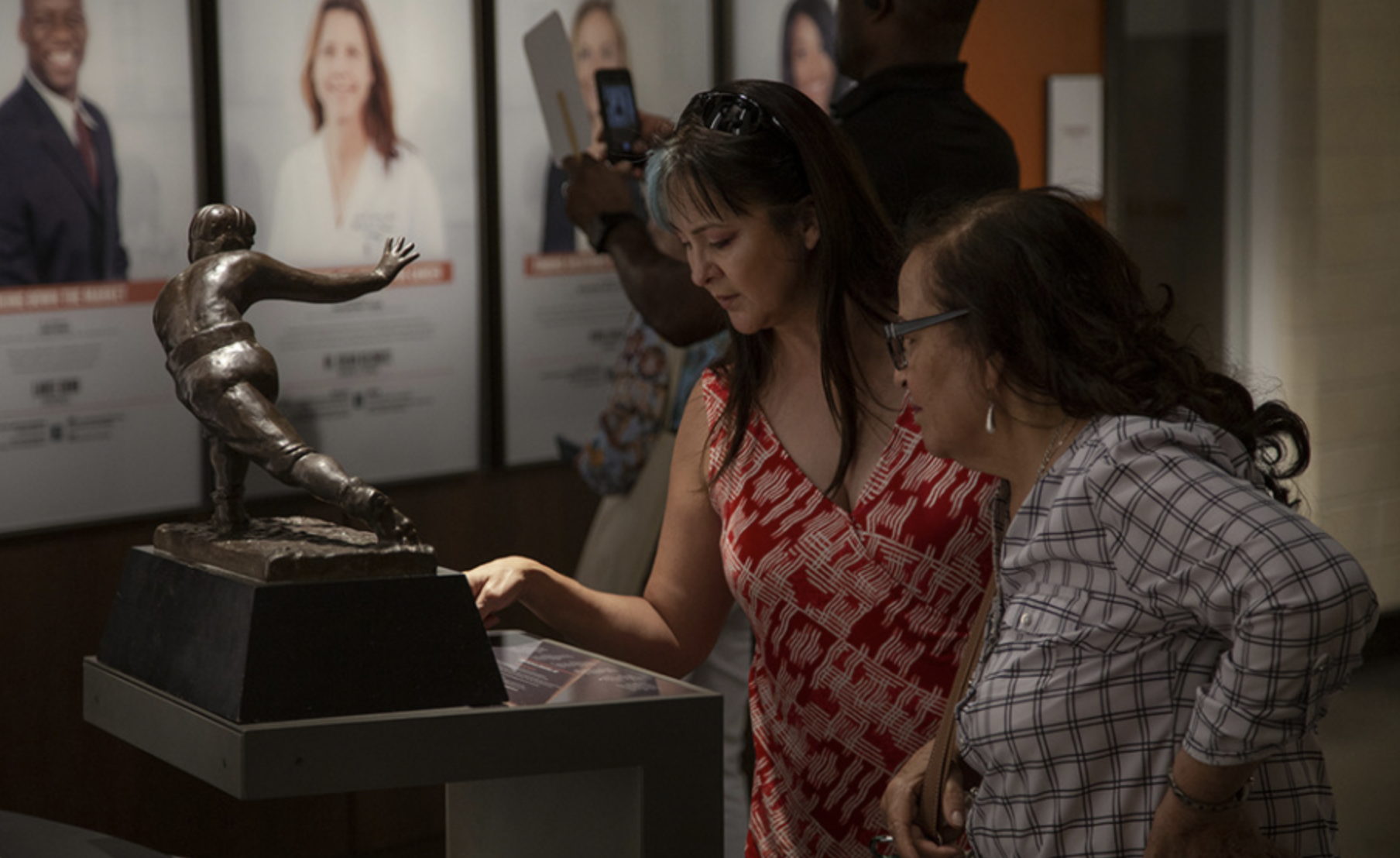
So that’s what we did. We created the largest hall of fame in college sports, inside the concourse at Darrell K Royal Memorial Stadium. No glass on the trophy cases, fans can touch the Heisman trophies. The hall sits in the middle of game-day traffic, not behind it. Every sport represented equally. Swimming beside football. Track beside basketball.
The surprise was not the trophies. Everyone has trophies. The surprise was the statement: every athlete who has ever worn this uniform is part of one story, and today, that story is yours. That is what a facility is supposed to do. Not describe an outcome. Produce one.
The Boardroom Case: Experience Is Not the Last Line Item
I hear the same objection in enrollment offices and athletic departments alike. “We understand the value of experience, but the budget went to construction.” My parents used to say at the cafeteria, “Your eyes are bigger than your stomach.” That’s most institutions. They want experience, they understand experience, but they’ve already eaten everything else.
I want to reframe that conversation entirely. What if experience were not the last line item but the first principle? What if you decided what story to tell before you decided what walls to build? What if the HVAC got figured out after you knew what the space needed to make people feel?
This unsettles facilities teams and challenges architects. It disrupts the entire capital planning process. It also works. Our clients who prioritize experience from the beginning spend less overall and achieve better outcomes, because when you know what experience you are creating, every decision becomes cleaner. You stop overbuilding in some areas and underbuilding in others.
The numbers are not soft. Every welcome center we’ve designed, enrollment lifted. Every fan experience zone, attendance up, concessions up, merchandise up, sponsor renewals up. These are not feelings. These are facts.
Oregon’s out-of-state applications: up 18 percent. The Kansas City Chiefs hall of fame transformation: season ticket renewals up 12 percent, merchandise sales in the hall up 40 percent. FC Barcelona’s pre-construction experience center for the renovated Spotify Camp Nou; built with immersive technology to let buyers feel opening night before a brick was laid, sold 90 percent of initial premium products immediately, projecting more than 120 million euros in annual premium revenue.
These are not coincidences. They are correlations with clear causation. Inexperience is expensive. Bad experience is expensive. No experience is catastrophic.
Inexperience is expensive. Bad experience is expensive. No experience is catastrophic.
The Framework That Gets You There
When I talk about what Advent actually does, I use the CARE framework. Not because frameworks are inherently useful (the world has enough of those) but because after 25 years and more than 2,500 projects, this is what we consistently observe in every experience that genuinely moves people.
Captivate: break their mental model immediately. When we worked with Stanford on their Home of Champions, we did not start with trophies and directors’ cups and memorabilia. We started with the stories of student-athletes and the process of becoming champions; the work ethic, the commitment, the scholarship. A Forbes contributor who visited wrote: “What I learned from my first visit is that the focus is not on trophies and rings. It’s all about the scholar-athlete.” That was the intent, executed precisely. Don’t confirm what they expected to find. Make them recalibrate.
Amplify: take the authentic DNA of the institution and make it impossible to ignore. Not louder… deeper. This is where StoryMining earns its value. When we surfaced Oregon’s themes of curiosity, belonging, and natural inspiration from 20-plus stakeholder conversations, those were not invented. They were discovered. The amplification is the act of making what is already true unavoidable.
Resonate: where science meets specificity. We measure emotional response (heart rate, eye tracking, engagement) but we also pay attention to the qualitative signals. The sharp intake of breath. The moment a parent stops taking notes and just looks. These are data points that tell you whether the experience is landing where it needs to land.
Empower: the hardest one for institutions to embrace. It means letting go of the impulse to tell the audience what to think. The University of Texas hall of fame does not have glass on the trophy cases because fans are not meant to look at the trophies. They are meant to touch them. Own them. The experience co-creates the brand with the audience, and because they own it, they evangelize it.
The practical tool that bridges research into design is what we call the Think-Feel-Remember-Do framework. Before you design a single element of the visit experience ( a tour route, a welcome center installation, a recruitment suite, a donor hospitality space) you need to answer four questions. What do we need this audience to think when they arrive? What do we need them to feel while they’re here? What do we need them to remember when they leave? What do we need them to do as a result? Every design decision flows from those answers. Every element earns its place or it doesn’t.
Walk Your Own Building
The University of Tennessee’s chancellor, Donde Plowman, said something after we completed their project that I have repeated more times than almost anything else in this work. “You told us we had so many stories. We really didn’t believe you.” She’d been skeptical of consultants who promise to find your story. “We thought we knew ourselves. We thought if we had compelling stories, we’d already be telling them.”
That is the paradox every institution faces. You cannot see your own belonging. You are too close to it. The stories that would move a 17-year-old from across the country to choose your campus are invisible to you because you have known them so long you cannot imagine not knowing them. The role of StoryMining is to surface what is already there, not to invent a narrative, but to make the real one visible and then build an experience around it.
Here is a practical challenge for anyone reading this: walk your own building tomorrow morning. Early, before anyone else is in it. Move through it the way a first-generation student moves through it on a campus visit with their parent, carrying the question of whether this investment will actually change their family’s trajectory. Move through it the way a top recruit moves through it, evaluating whether this program sees them as a person and not just a statistic.
Ask yourself: if this space were the only thing speaking for this institution, what decision would it drive?
If the answer makes you uncomfortable, that discomfort is worth something. That is where the work begins.
The good news is that you do not need a $50 million renovation to start. You need clarity about what your institution actually stands for, a methodology to surface it, and the discipline to build every experience decision from that foundation. The institutions that figure this out first will not just recruit more students. They will recruit the right ones. They will not just attract donors. They will create evangelists.
And in an enrollment environment defined by skepticism and shrinking pools, an evangelist is worth more than any recruiting budget line item you have.

Grace Johnson
Senior Client Engagement Manager | “The Commissioner”
Advent is a Nashville-based experience creation firm specializing in digital storytelling for sports venues, universities, and athletic facilities. Get in contact to learn more about how similar storytelling and technology can inspire and drive value for your organization.