

Experience Centers
Your Experience Center Shouldn’t Just Look Good. It Should Move Business Forward.
Italian Leather Doesn’t Close Deals
Not long ago, I was talking with a corporate executive about their upcoming headquarters redesign. We were standing in their existing executive briefing room. A space with stunning floor-to-ceiling glass, high-end Italian leather chairs, and a massive 4K video wall looping a pre-recorded ocean view. On paper, it was built to impress.
Then he said something that stuck with me: “Nastashia, clients walk in, say ‘wow,’ sit down, and then we give them the exact same 60-slide PowerPoint we could have emailed them. The room is impressive, but it’s completely passive. It isn’t helping us win.”
That moment captured a massive shift happening across the industry.
For years, corporate experience centers were treated like digital museums. You brought a client in, showed off your history, demonstrated a product or two, gave them lunch, and sent them on their way. It was a show-and-tell environment designed to look good for twenty minutes.
Today, the playbook has completely changed.
Industry leaders aren’t building physical spaces just to showcase their brand. They’re using them as strategic business tools–environments engineered to drive sales, explain complex solutions, engage top talent, facilitate collaboration, and solve real business problems.
The physical space is no longer just the backdrop for the business strategy. The space itself has become part of the strategy.
The question is no longer: “How do we make this space look impressive?” It’s: “What does this space need to accomplish for the business?”
Moving Beyond the Show-and-Tell
Whether you’re looking at recent research from Gensler or watching how tech giants like Microsoft run their global Experience Centers, the data is undeniable: companies are pivoting from static “briefings” to active “engagement.”
Corporate leaders are being asked to make every square foot work harder. A single environment is expected to support sales enablement, customer education, executive recruitment, partner onboarding, and brand storytelling all at once.
That creates a distinct challenge: How do you design one space to serve multiple business objectives without making it feel like a jack-of-all-trades and master of none?
That’s where we step in at Advent.
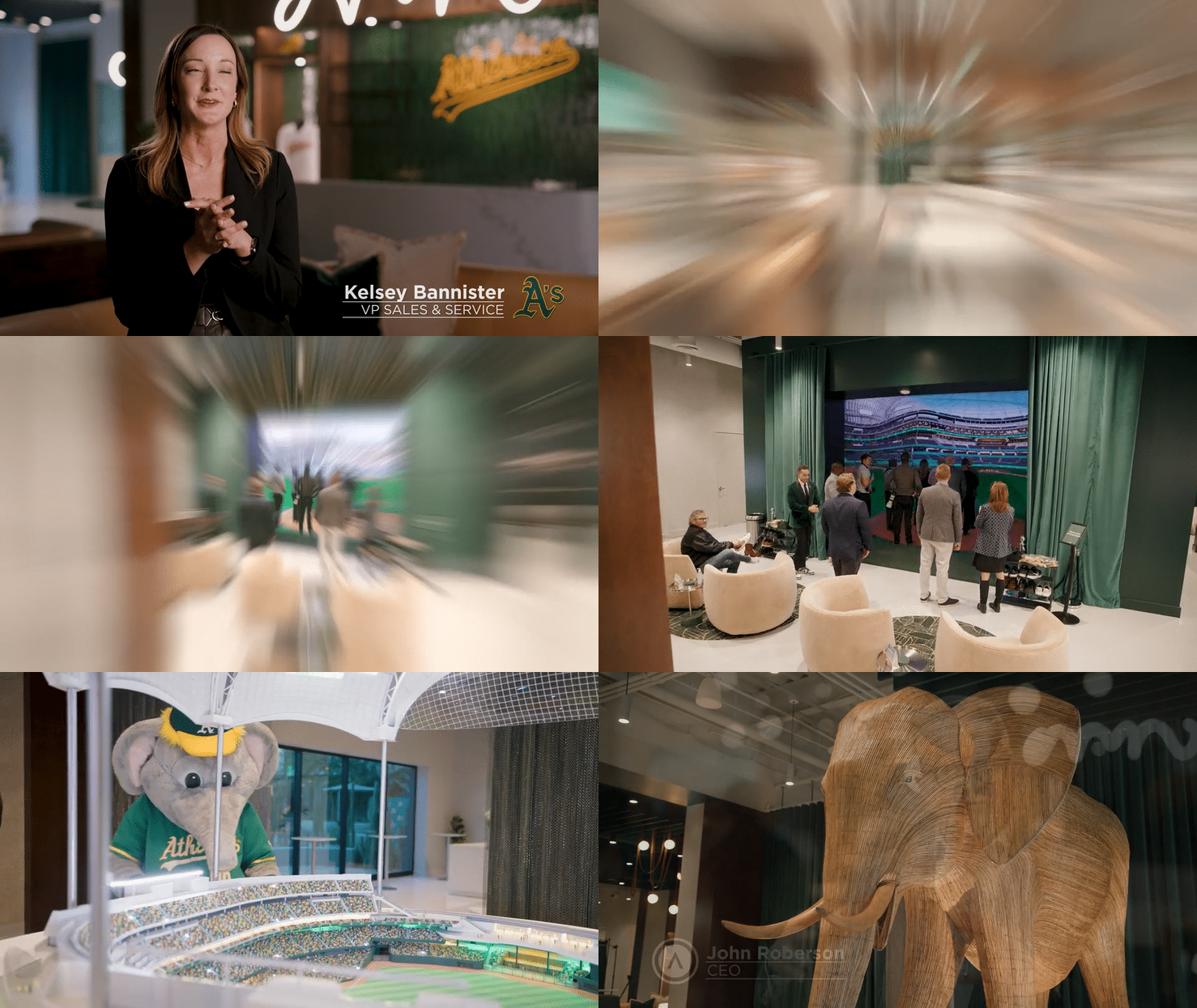
Take the A’s Ballpark Experience Center in Las Vegas. The Athletics faced a massive business challenge: sell premium suites and season tickets for a ballpark that didn’t exist yet, while winning over corporate sponsors, lifelong fans, and a brand-new local community. Instead of building a passive room with static renderings, we partnered with A’s leadership through our Sandbox process to turn their sales environment into an adaptable, multi-use strategic tool.
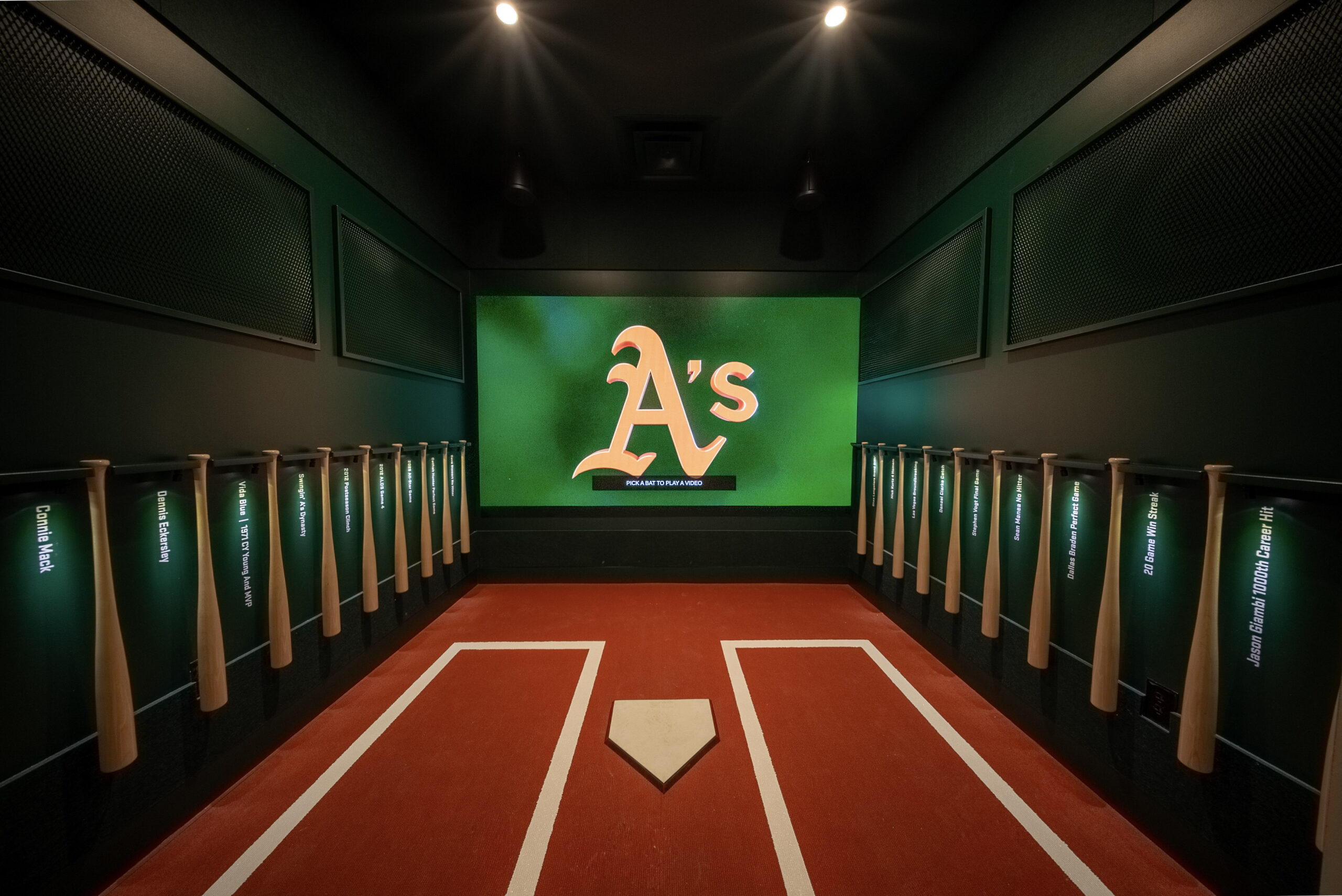
Powered by our Advent Operating System™ (AOS), we designed the space to shift its narrative depending on who walks through the door. Corporate partners can step inside an immersive digital environment to explore their exact future suite sightlines, while local families can interact with bat installations that anchor them in the team’s rich tradition. We didn’t build a space that looked impressive for twenty minutes–we built a flexible platform that helped the A’s build deep emotional trust, communicate a complex future vision, and drive real business outcomes long before construction was even started.
5 Principles for Building a Strategic Experience Center
If you’re evaluating your current briefing space or planning a new corporate environment, here are five principles we use to ensure the physical investment drives measurable return:
-
Start With the Conversation You Want to Change: Before talking about finishes, screens, or floor plans, ask yourself: What do we want our prospects to think, feel, remember, and do after walking out of this room? If the space doesn’t intentionally steer the conversation, it’s just an expensive decoration.
-
Design Around the Audience, Not the Ego: A prospective client, a new hire, a strategic partner, and a board member don’t experience a room the same way. Identify your distinct audiences and build interactive moments tailored to what matters most to each of them.
-
Turn Complex Ideas Into Tangible Experiences: If your core product or software is complex, don’t force your audience to work hard to digest it. B2B decision-makers don’t want to read dense text off a wall. Use spatial storytelling, real-time visualization, and physical interaction to make abstract concepts feel simple, clear, and immediate.
-
Make the Space Multi-Threaded: An experience center shouldn’t sit empty when a client pitch isn’t happening. Design it from day one to support executive meetings, employee onboarding, town halls, and collaborative problem-solving—creating what we like to call “no dark days,” where the space is always working and delivering value.
-
Build for Evolution, Not Just Opening Day: Technology shifts and business priorities pivot. The smartest corporate environments are built with flexible software and modular frameworks (like our Advent Operating System) so your space can update instantly without requiring a full renovation every three years.
The Advent Takeaway
The best experience centers aren’t built to impress someone for 20 minutes. They’re built to influence what happens next.
Because let’s be honest–Italian leather chairs are just Italian leather chairs. Every corporate boardroom has them. But a custom bat-vending machine? An interactive wall where you tap a bat on home plate to bring franchise history to life? Have you ever even seen that before?
When your client or stakeholder walks out that door, you shouldn’t be wondering how it went. You should be completely confident that their experience was transformative. You aren’t left guessing what happens next. You already know the exact action they’re going to take because the space was engineered for that very moment.
When physical environments are designed around business outcomes, they stop being passive show-and-tell rooms. They become high-impact sales tools that help YOU create better conversations, stronger relationships, shorter sales cycles, and sustainable growth.

Written by Nastashia Savoie, Sales Account Executive
For over 25 years, Advent has been creating emotionally resonant experiences for leading brands including AT&T, Fanatics, the Dallas Cowboys, and Stanford University. Our proprietary StoryMining methodology ensures that every project starts with the story, not the technology.