

Corporate Offices
Experience Centers
Experience Design
Thought Leadership
How Does a Visitor Center Fit Into Your Headquarters Workplace Strategy?
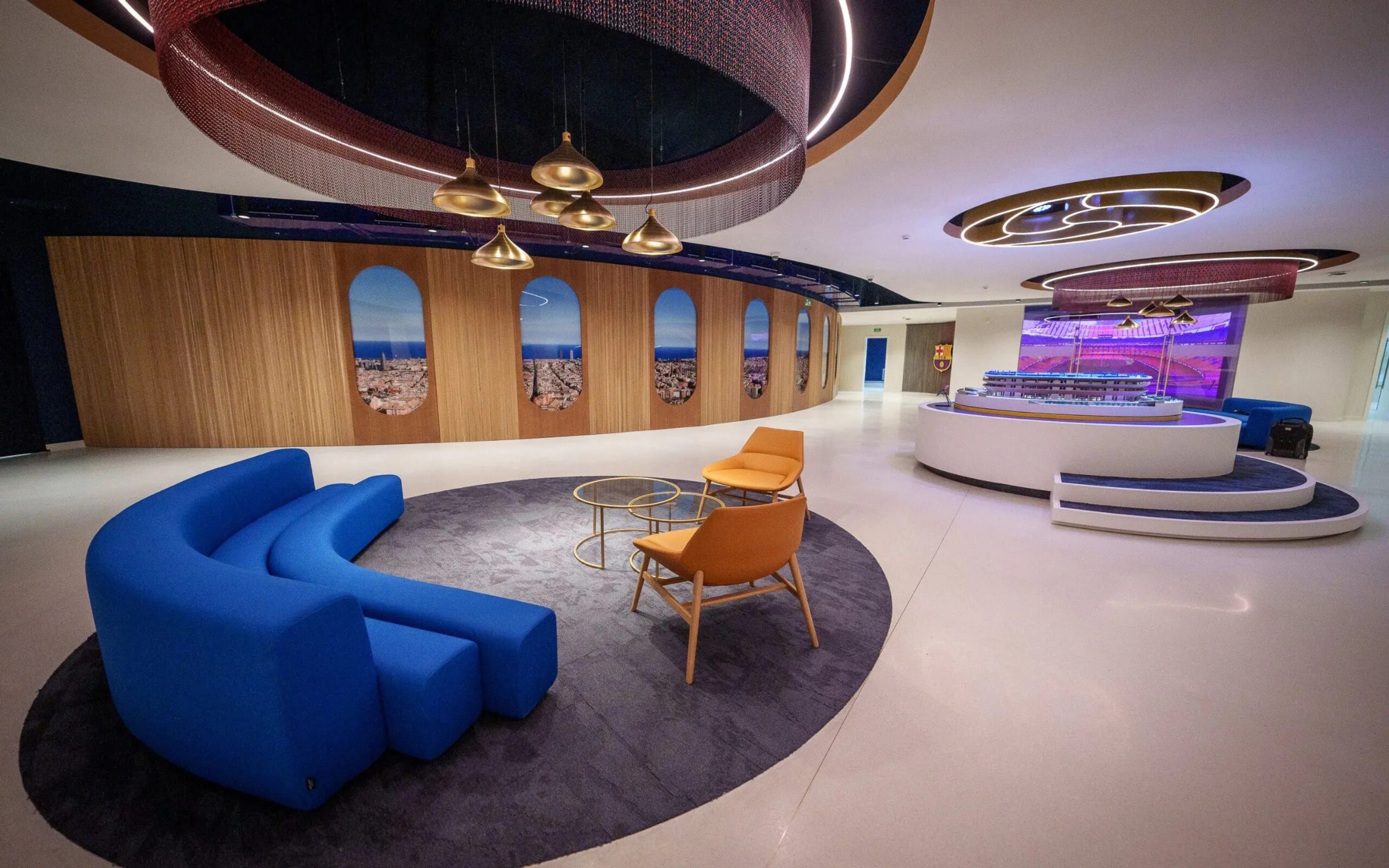
We’ve all walked through hundreds of corporate lobbies over our careers. Would you agree that most are forgettable?
The reception desk, some corporate awards gathering dust, maybe a founder’s photo looking stern from 1987?
Then there’s the other kind: the spaces that stop you mid-stride, that make you pull out your phone not because you’re bored, but because you need to capture what you’re experiencing.
Why Traditional Headquarters No Longer Meet Employees’ Deeper Needs
Let me be direct about something most workplace consultants won’t say: your employees don’t need your office anymore. Not in the way they used to. They’ve proven they can be productive from kitchen tables and spare bedrooms. The spreadsheets still get built. The deals still close. The code still ships.
What they can’t get at home (what nobody can replicate remotely) is the visceral experience of understanding what your organization stands for and where it’s headed.
This is where the traditional thinking about visitor centers gets it backwards. Most organizations treat these spaces as amenities for other people (prospects, clients, recruits, the occasional VIP tour). They’re built as showcases, museums of achievement designed to impress outsiders while employees walk past them every day without a second glance.
That’s a $2 million missed opportunity.
Designing Visitor Centers to Serve Employees and Reinforce Culture
At Advent, we’ve completed over 2,500 experience design projects. The pattern we see in the most successful ones? The organizations that get ROI from their visitor centers are those that designed them primarily for their own people.
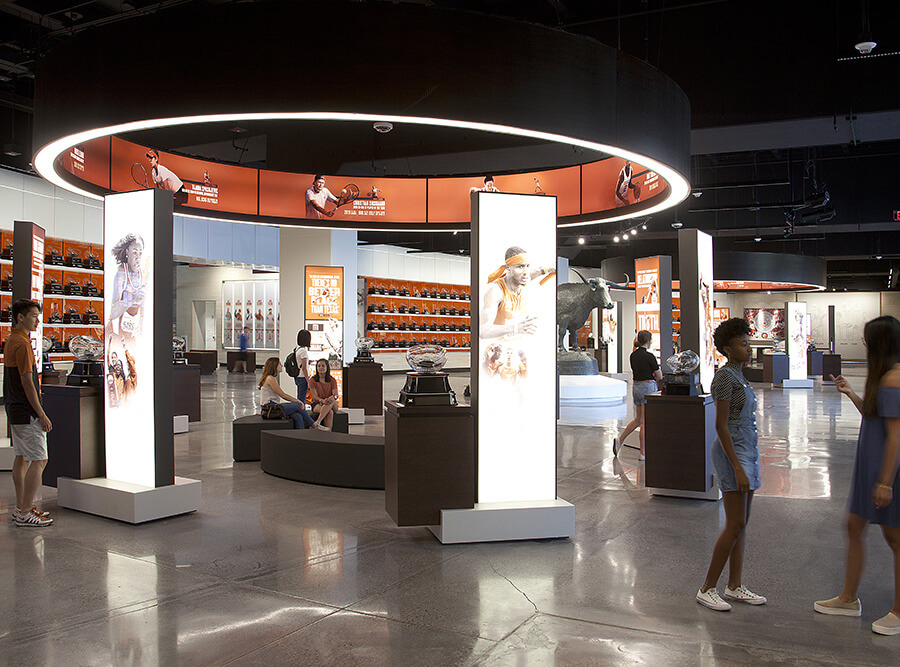
Think about it. When we worked with the University of Texas on their Athletics Hall of Fame, the primary audience wasn’t prospective students or donors (though they benefit enormously). It was current student-athletes who needed to understand the weight of the burnt orange jersey, the lineage they’re joining, the standard they’re being asked to uphold.
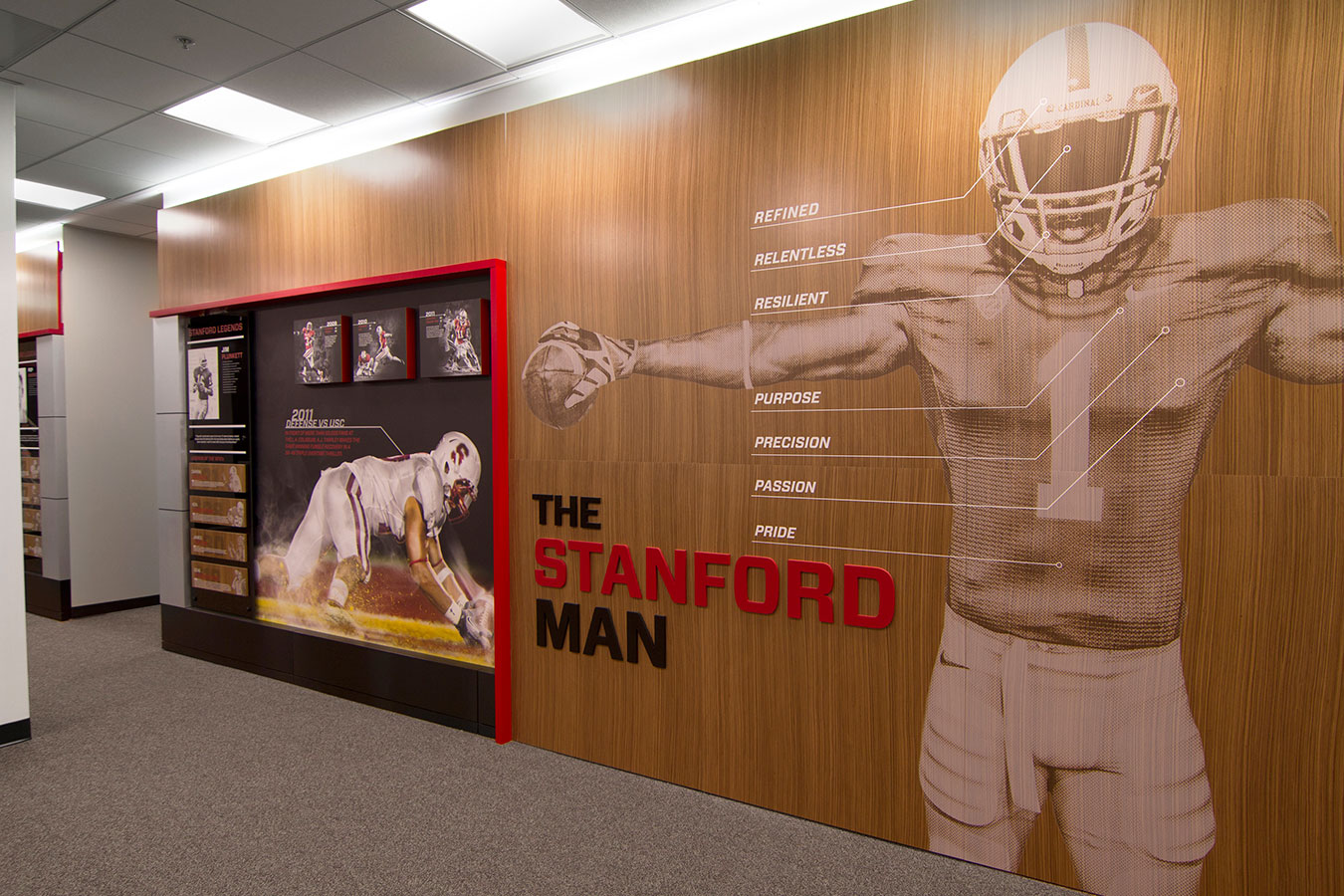
When Stanford asked us to develop the “Stanford Man” concept for their football facility, we weren’t building a museum. We were creating a daily reminder of character, excellence, and the specific qualities that define their program culture. Recruits see it on their visits, certainly, but scholarship offers don’t get signed during tours. They get signed after months of relationship building where current players, coaches, and staff continuously reinforce what Stanford football means.
Your organization’s visitor center should function the same way.
Three Strategic Roles Visitor Centers Play in Culture, Story, and Talent
1. Turning Stated Values Into Lived, Visible Culture
Every organization claims to have values. Most have them printed on breakroom posters. The exceptional ones have them embedded into physical experiences that you can’t ignore.
Let’s discuss a potential scenario. A Fortune 500 tech company. The leadership team is left frustrated that their innovation culture felt like marketing copy rather than lived reality. Engagement surveys showed employees didn’t believe the company truly valued risk-taking and creative problem-solving.
Their visitor center becomes the antidote. Instead of a static timeline of company achievements, they create an interactive journey through the company’s biggest failures… the product launches that flopped, the strategic bets that didn’t pay off, the pivots that felt terrifying at the time. Each failure story culminated in what the organization learned and how it led to later success.
Here’s what will happen. New employees start taking team photos in front of the “Epic Fails Wall.” Managers begin bringing their teams through when someone took an intelligent risk that didn’t work out. The space becomes proof that the stated values aren’t just aspirational; they are historical fact.
When prospects visit now, they’re not seeing a manufactured culture pitch. They’re seeing evidence that the employees believe in.
2. Aligning Leadership Around One Clear Strategic Story
The second role is more subtle but possibly more valuable: a great visitor center forces you to clarify your strategic story.
I can’t tell you how many times we’ve started a discovery process with a client who thinks they know their brand narrative, only to find that their executive team tells eight different versions of the company’s origin, mission, and future direction. The CFO emphasizes financial discipline and sustainable growth. The Chief Innovation Officer talks about disrupting industries. Marketing focuses on customer-centricity. HR highlights the people-first culture.
They’re not wrong. They’re just incoherent together.
Designing a visitor center is strategic planning disguised as spatial design. You cannot create a compelling 20-minute journey through your organization’s story without first agreeing on what that story actually is. What’s the through-line? What are the non-negotiables? What’s changed and what’s remained constant? Where are you headed and why should anyone care?
This process, what we call StoryMining at Advent, has as much value for internal alignment as it does for the external audiences who’ll eventually walk through the space. We partnered with Samford University to research how physical environments influence decision-making and behavior, and one finding stood out: people internalize narrative when they physically move through it.
Reading your company’s mission statement on the website? Forgettable. Walking through a carefully sequenced space that demonstrates your organization’s evolution, values, and vision? That stays with you.
Your employees need this as much as your prospects do. Maybe more.
3. Using Your Visitor Center to Attract and Retain Purpose-Driven Talent
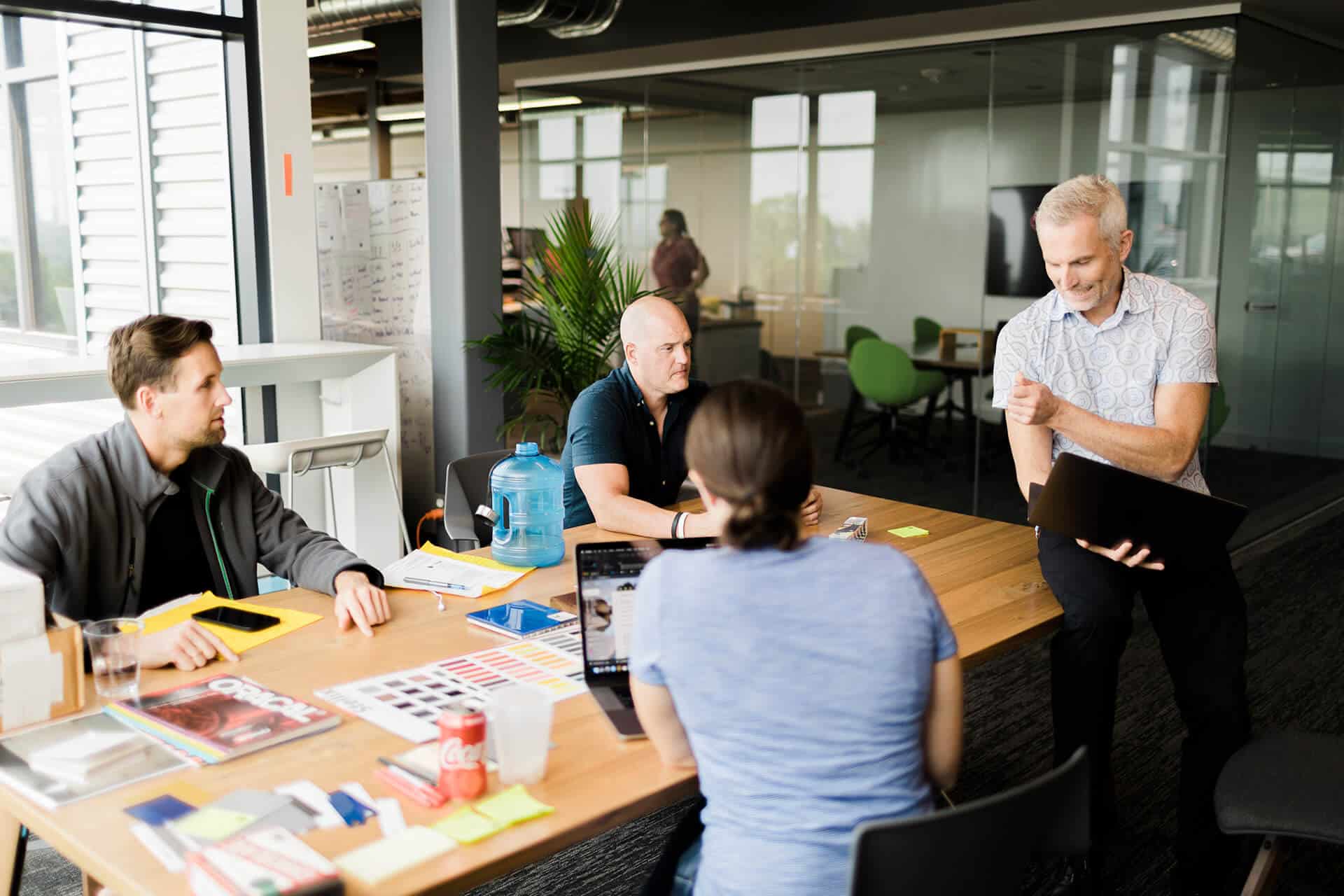
Let’s talk about the elephant in the hybrid workplace: if people can work from anywhere, why should top talent choose to work for you?
Compensation matters, obviously. Benefits matter. Work-life balance matters. What really happens? Something that DEI consultants and HR tech platforms don’t want to acknowledge? Meaning matters more than all of them, especially for the people you most want to hire.
The best people, the ones who will drive your organization forward, are making choices based on purpose, impact, and whether they can see themselves as part of something significant. They’re not just looking for a job. They’re looking for a story they want to join.
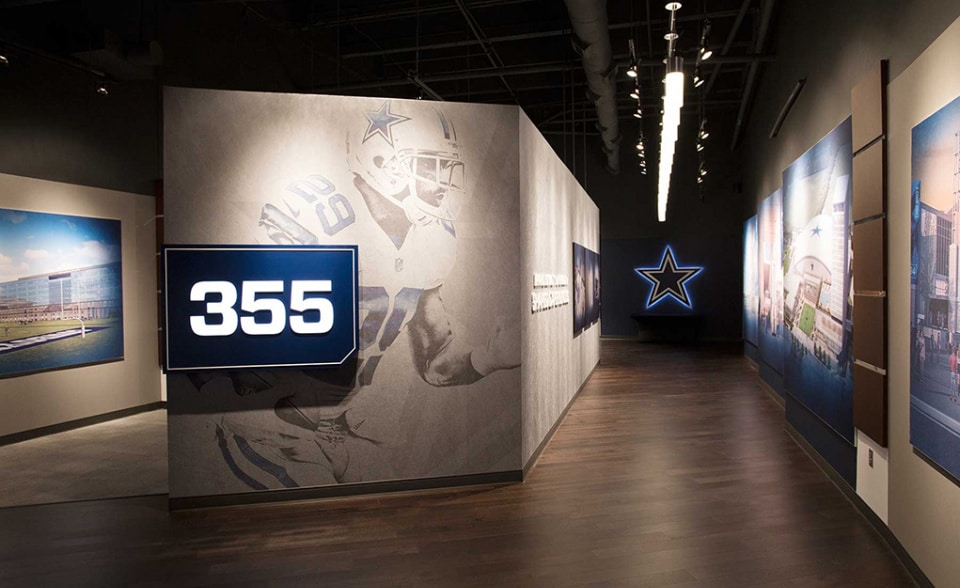
When we work with professional sports teams, they understand this instinctively. A recruit touring the Dallas Cowboys‘ facility isn’t just seeing impressive amenities. They’re being invited into a legacy. The question isn’t “is this a nice place to work?” It’s “can I see myself as part of this story?”
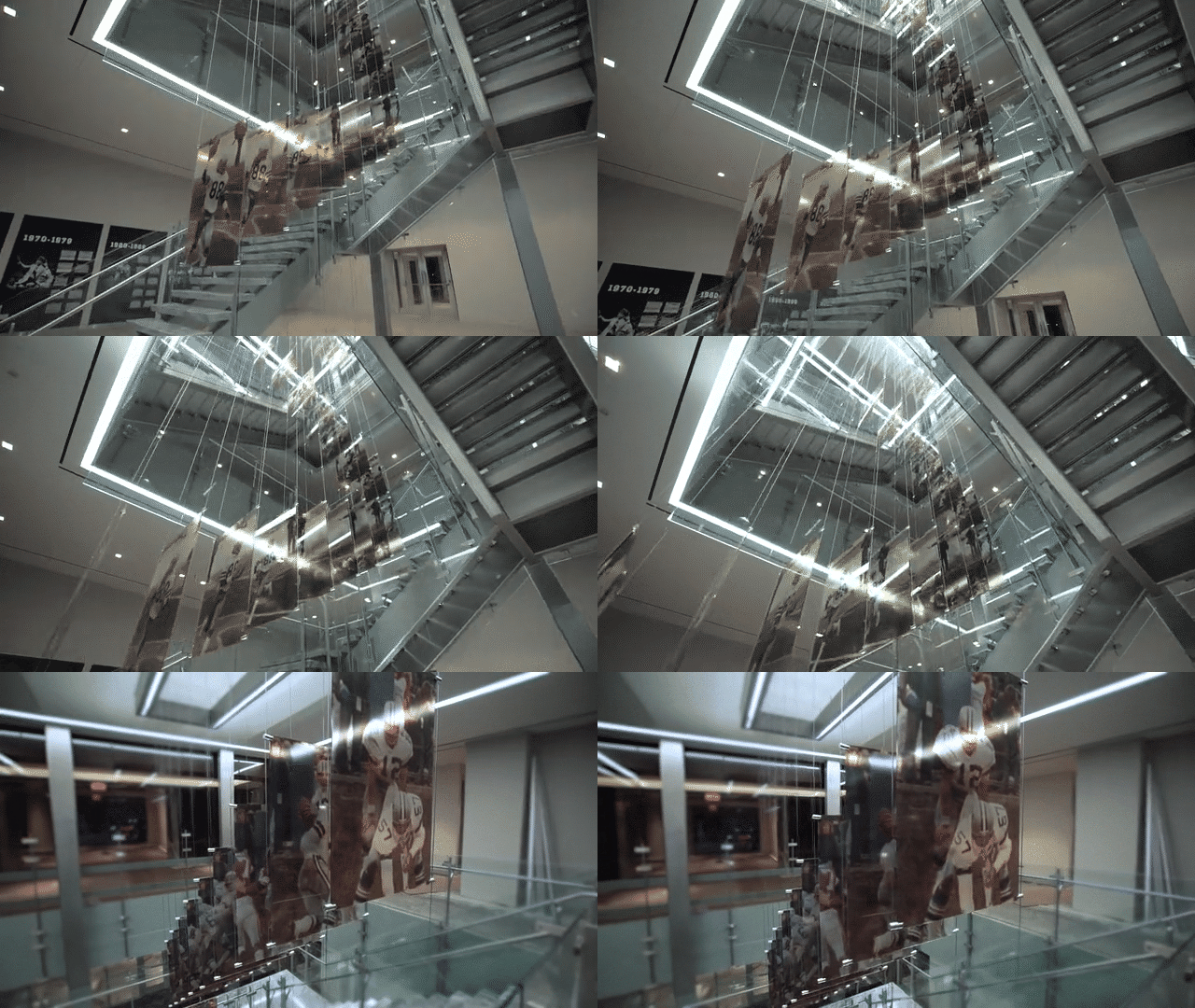
Your visitor center should trigger the same response.
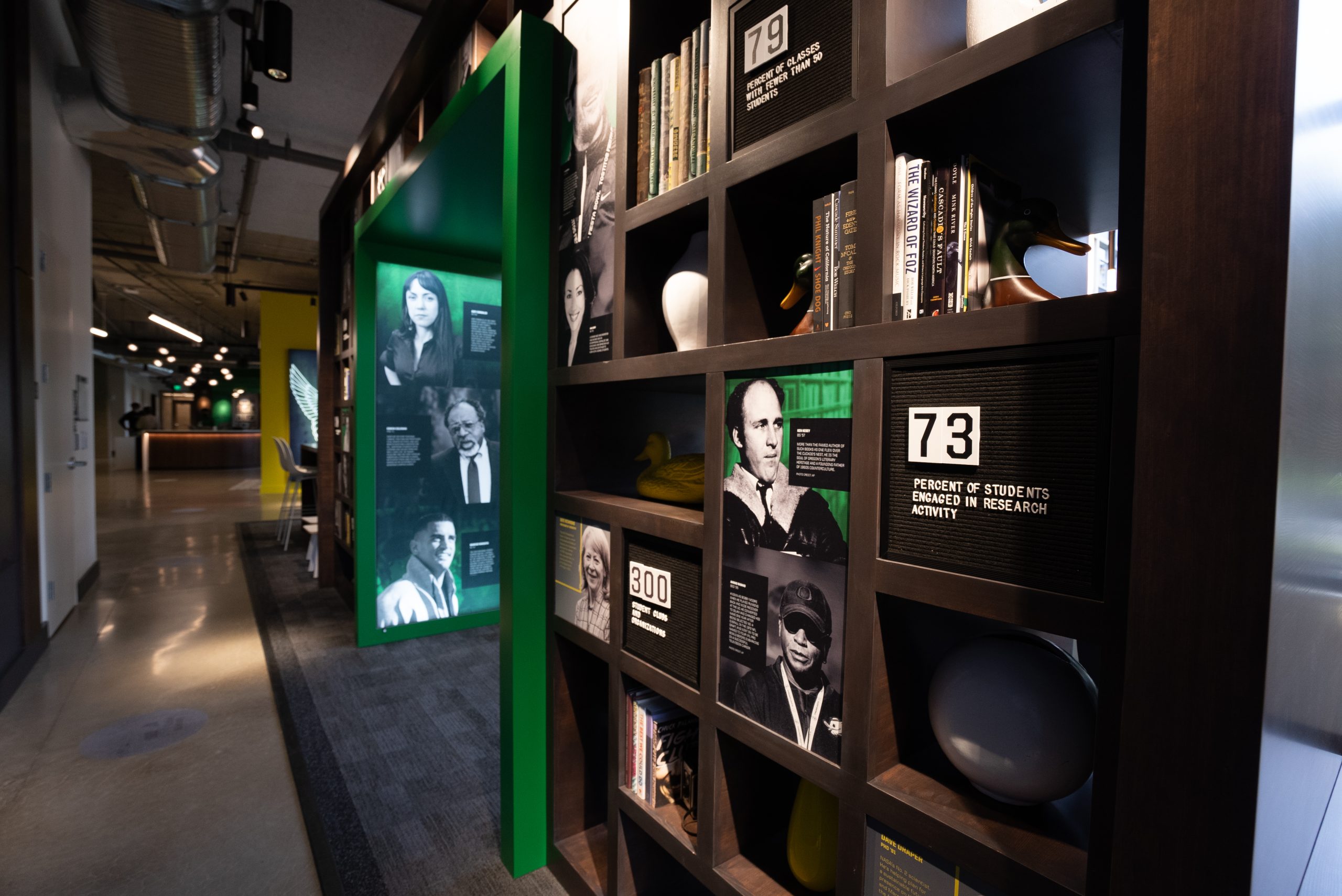
We recently designed a welcome center for the University of Oregon that includes an interactive alumni wall showcasing how graduates have gone on to create impact in their fields. It’s searchable by major, by decade, by industry. Students can trace connections between their current professors and breakthrough innovations in their fields of study.
The space was designed for prospective students on campus tours. But it’s become a destination for current students having existential crises about whether their degree will matter, for graduates returning to campus and finding their own contributions recognized, for faculty showing students the real-world applications of what they’re teaching.
That’s retention architecture, not just visitor experience design.
How to Tell If Your Visitor Center Drives Results or Is Just Decorative
Here’s how to tell the difference:
Decorative visitor centers:
- Focus on impressing outsiders with scale and budget
- Tell the “greatest hits” story (awards, milestones, famous clients)
- Remain static after opening day
- Get designed by architects who focus on aesthetics over narrative
- Measure success by “wow” reactions during tours
- Sit empty most of the time
Strategic visitor centers:
- Design experiences that serve multiple audiences including employees
- Tell an authentic, sometimes vulnerable story that includes challenges overcome
- Feature modular content systems that evolve as the organization evolves
- Get designed collaboratively with stakeholders who understand culture, not just space
- Measure success by behavioral change (recruitment conversion, engagement scores, client close rates)
- Generate consistent traffic because they’re integrated into daily operations
The difference isn’t about budget. We’ve seen $500K visitor centers that function strategically and $5M ones that are pure vanity projects. It’s about intention.
How Strategic Visitor Centers Make Headquarters Essential in Hybrid Work
Ironically, the shift to hybrid work has made strategic visitor centers more valuable, not less.
Think about the problem: Your people are at headquarters 2-3 days a week now instead of five. You’ve got beautiful office space that sits empty 60% of the time. The executives who fought remote work are anxiously watching utilization metrics and questioning the lease agreements.
A strategic visitor center solves this by making headquarters about more than individual productivity.
When someone comes to the office, it shouldn’t be to accomplish tasks they could do anywhere. It should be to connect with mission, with team, with the larger story they’re part of. The office becomes a destination for meaning-making, not just task completion.
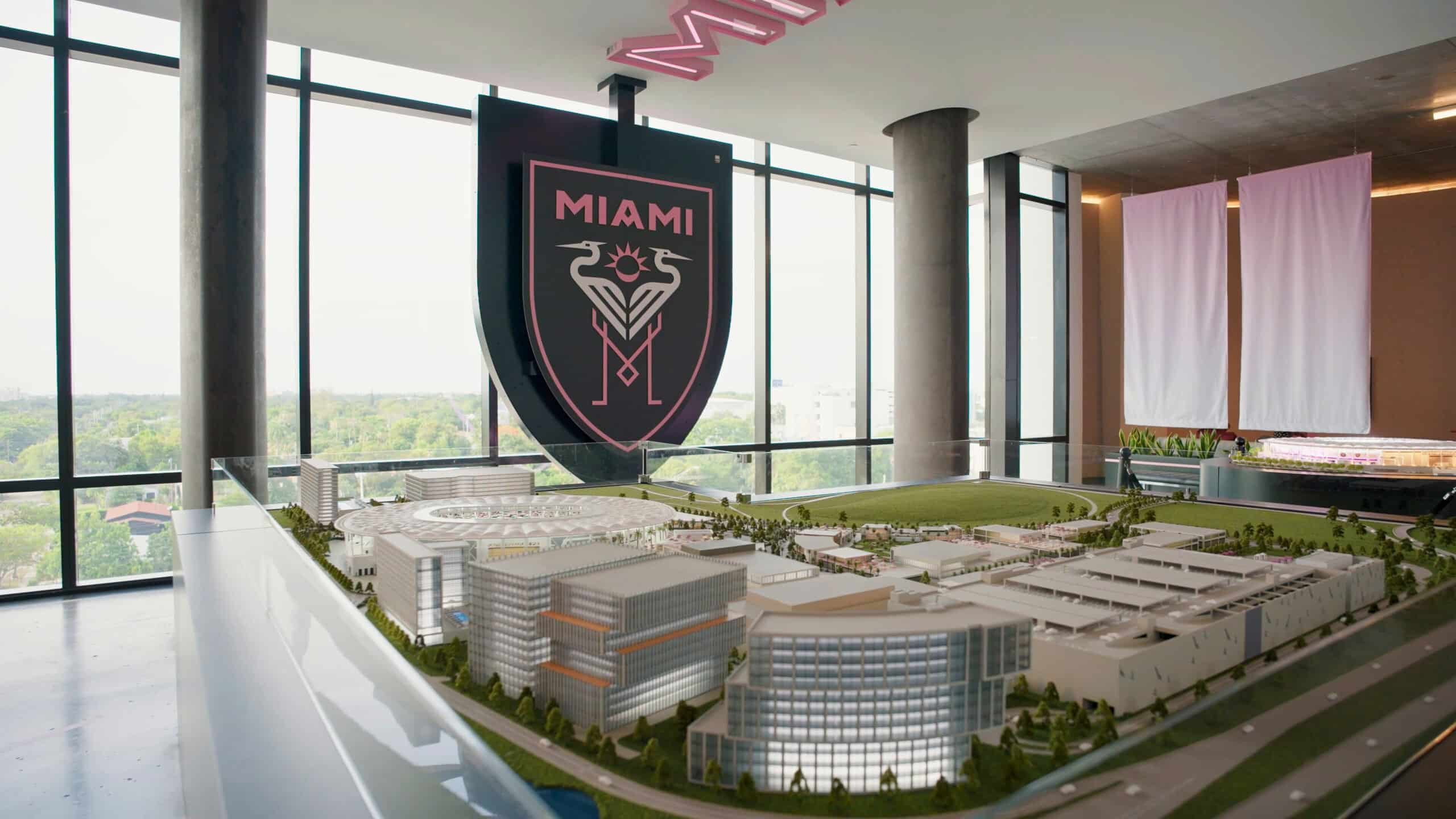
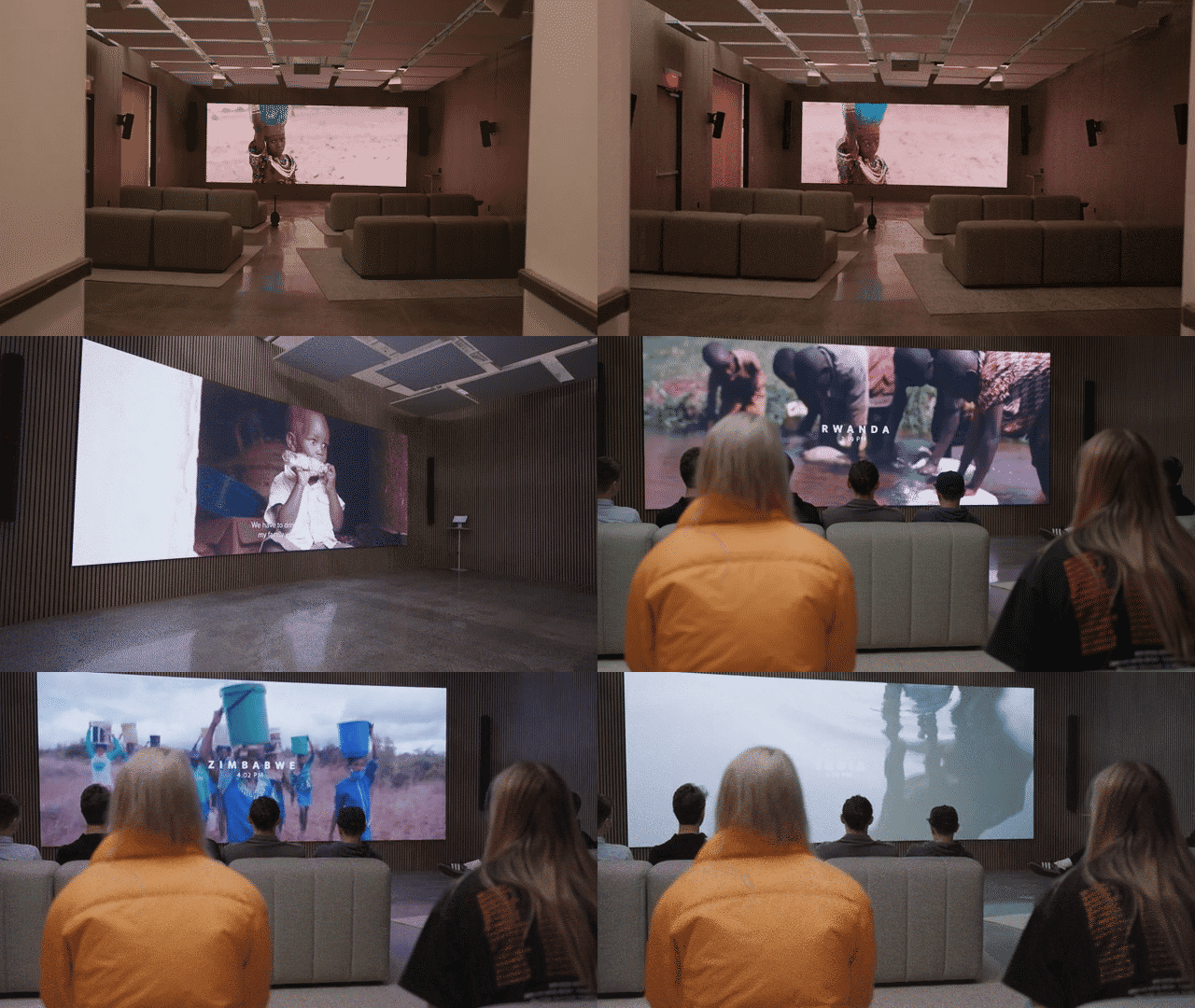
This is why we’re seeing forward-thinking organizations integrate their visitor centers directly into employee spaces rather than segregating them into separate lobbies. The SoFi Stadium Experience Center we designed isn’t just for prospective investors, it’s the primary gathering space for current employees. The Charity: Water Experience Center isn’t just for donors, it’s where the team lives daily.
When your visitor center serves your people first, headquarters becomes essential again.
Using Technology to Support Visitor Center Storytelling, Not Replace It
I’d be remiss not to address technology since it comes up in every visitor center discussion. Yes, we integrate interactive displays, projection mapping, RFID-enabled experiences, AI-driven personalization. We recently collaborated with the A’s on an Immersive Cube for stadium sales that Sports Illustrated covered, absolutely cutting edge stuff.
But here’s what 20 years in this business has taught me: technology should enable storytelling, not replace it.
The worst visitor centers we’ve audited are technology graveyards, interactive touchscreens with outdated content nobody maintains, VR experiences that were impressive in 2019 but feel clunky now, mobile apps that required three downloads and never worked quite right.
The best ones use technology invisibly, in service of emotional connection. They use digital displays to show real-time data that proves claims about company culture (live feed of employee volunteer hours, current R&D projects in development, customer testimonials updating continuously). They use spatial audio to create intimate moments within large spaces. They use lighting to guide attention and create narrative pacing.
Technology should feel inevitable within the story, not like the story itself.
Key Questions to Answer Internally Before Investing in a Visitor Center
Before you invest in a visitor center, you need clarity on some key questions:
- What story are you actually telling? Not the aspirational story. Not the marketing copy story. The true story. If I interviewed 20 random employees about what your organization stands for and where it’s headed, would I hear consistency or confusion?
- Who is your primary audience? If you say “everyone,” you’re building a decorative space. Strategic visitor centers have a primary audience and clear secondary audiences, with design decisions made in priority order.
- What behavior change are you trying to create? Visitor centers that succeed have measurable outcomes attached to them from day one. What should people do differently after experiencing this space? Apply for jobs? Make purchasing decisions? Increase retention? Donate? Refer others?
- How will this space integrate into headquarters operations? If it’s a destination for special tours only, you’re missing 90% of the value. How will employees interact with this space daily or weekly? What programming will keep it active?
- What’s your content strategy for years 2-5? The space will need to evolve. How will you keep it current? Who owns that responsibility? What’s the budget for ongoing updates?
What Your Headquarters Is Really Competing With for Employees’ Time
Here’s the thing most executives miss: your headquarters isn’t competing with other office spaces or with employees’ home offices.
It’s competing with every meaningful experience your employees could be having somewhere else.
They could be at a conference that inspires them. They could be at a coffee shop having a connection-building conversation with a mentor. They could be traveling and experiencing things that broaden their perspective. They could be at home with family, which feels increasingly like where they should be spending time.
For headquarters to win that competition, it needs to offer something irreplaceable. A strategic visitor center: one designed as much for your people as for your prospects that makes headquarters essential again. Not for individual productivity, but for collective meaning.
That’s not a nice-to-have amenity. In a world where top talent can work from anywhere, that’s the whole ballgame.
Next Steps for Designing a Strategic, Employee-Centric Visitor Center
If you’re considering a visitor center as part of your headquarters workplace strategy, start by letting go of the assumption that it’s primarily for visitors. Design it for your people first. Make it the physical manifestation of your strategic narrative. Build it to evolve as your organization evolves.
And for what it’s worth, if you’re trying to justify the investment to a CFO who’s focused on cost-per-square-foot metrics, you’re having the wrong conversation. The right question isn’t “can we afford this?” It’s “can we afford not to have a space that codifies culture, aligns strategy, and makes our headquarters matter in a hybrid world?”
Because I promise you: your best competitors are asking themselves that question right now.
And some of them are already building the answer.

At Advent, we specialize in creating integrated fan experiences that honor legacy while embracing innovation. Our team combines expertise in physical design, digital integration, and sports culture to build recognition spaces that move people; emotionally, physically, and digitally. Let’s create your next chapter together.